Help
1.Introduction
AgroPAD(Agrochemical Physicochemical-properties Analysis Database) is a special agrochemical database to not only provide information about pesticides but also qualitative and quantitative evaluate pesticide-likeness of small molecules. We have collected information on all approved pesticides including 512 insecticides, 377 fungicides and 542 herbicides. CAS numbers, common names, 3D structures and physicochemical properties for these molecules are recorded in our database. This website also allows you to compute physicochemical descriptors and pesticide-likeness scores of small molecules to support agrochemical discovery.
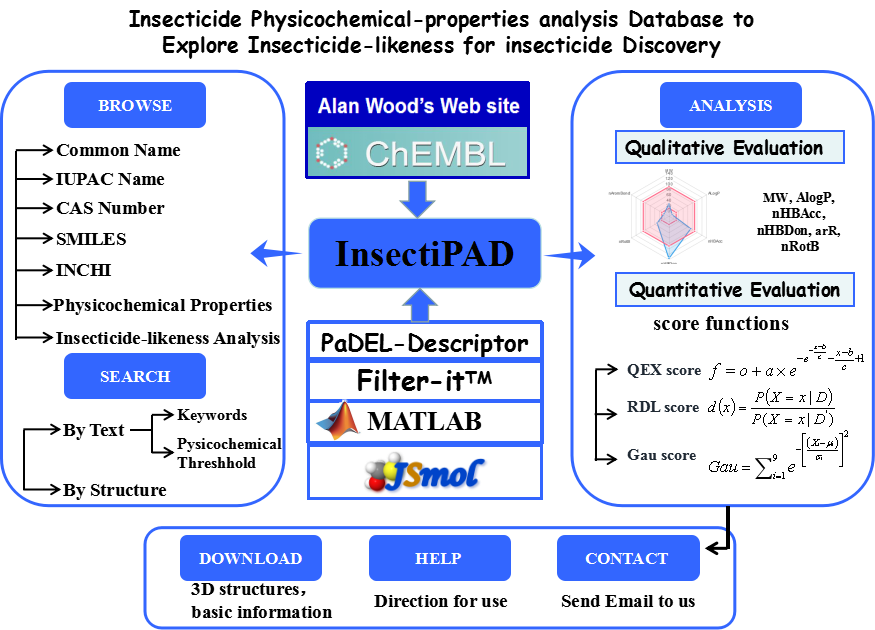
Fig 1. The Architecture of AgroPAD
2.Browser Recommendation
We tested our database using different browsers on different systems (IE10 or later on Windows, Firefox on Windows, Mac OS and Linux, Google Chrome on Windows, Mac OS, and Linux, Apple Safari on Windows and Mac os) to assure the normal display. The testing results showed good compatibility.
3.Browse Method
You can browse three classes of pesticides respectively. Structures and physicochemical properties of these molecules directly displayed in the Browse page, click ID-link to view more basic information, including common name, IUPAC name, CAS number, smiles, inchi, physicochemical properties, bioavailability radars and pesticide-likeness scores(insecticide-likeness scores, fungicide-likeness scores or herbicide-likeness scores).

Fig 2. Browse AgroPAD
4.Search Method
Pesticides can be retrieved through both a text-based keyword search and a structure-based similarity search. For text-based search, pesticides match the keywords will be showed. You can also refine your search by choosing some specific physicochemical characteristics for the compounds. For structure-based search, pesticide molecules with similar structure with your input structure will be presented.

Fig 3. Search AgroPAD
5.Analysis Method
Predicting the pesticide-likeness of experimental molecules is important in the discovery process. Our database can help you to analysis the pesticide-likeness of your compounds. The input is an user-defined structure generated by JSME. Your selected compounds with related physicochemical properties and their distribution histograms, bioavailability radars and pesticide-likeness scores (insecticide-likeness score, fungicide-likeness score, herbicide-likeness score) will be showed in a few minute. You can evaluate the pesticide-likeness of compounds by the Radar (the pink area represents the optimal range for each properties) and histograms at a first glance or according to the pesticide-likeness scores ( the higher the score, the better the pesticide-likeness of your compounds). These evaluating methods are not meant to be as accurate as virtual screening tools, but the results are indicators of compounds showing desirable pesticide-likeness physicochemical properties.

Fig 4. Analysis AgroPAD
6.Score Function Building
We establish quantitative assessments (QEX, RDL and Gau) to efficient prioritize pesticide-likeness compounds. Every approach relies on a small number of molecular descriptors which are relevant, accessible and easy to compute to describe the distribution of a set of molecules.
1.QEX(QEI, QEF, QEH) accurately describe six molecular properties(MW, LogP, HBA, HBD, nRotB, arR) over the three classes of pesticides (insecticides, fungicides, herbicides) respectively, parameterized by a,b,c,o coefficients computed for each distribution of pesticides properties. And the individual dfi (i molecular descriptor) was joined by computing geometric means and logarithm.

2.Gaussian function describes a more multivariate descriptors' distribution to ascertain pesticide likeness of small molecule compounds, including MW, LogP, HBA, HBD, PSA, nRing, nN, nO and nRotB. The values Xi represent the nine physicochemical properties respectively. The parameters μi and σi represent the average and standard deviation of each Xi.

3.Following bayesian probability theory, we randomly selected 1000 compounds from the ChEMBL database considered as a negative set, and pesticides as positive sets to build RDL function. P(X|D) is the probability of the property X given that a compound is a drug. P(X|D') the probability of the property X given that a compound not being a drug. We considered six properties(MW, LogP, HBA, HBD, nRotB, arR) used in QEX.

